☰☷

I-Ging

Das Buch der Wandlungen

0/500

Wähle 3 Hexagramme

0/3 Hexagramme

☰☷☵☲☳☴☶☱

Deine Lesung des I-Ging

Vergangenheit
Gegenwart
Zukunft

Das Orakel wird befragt…
Try I Ching Tarot now for free. Online reading with AI interpretation in seconds, no signup required.

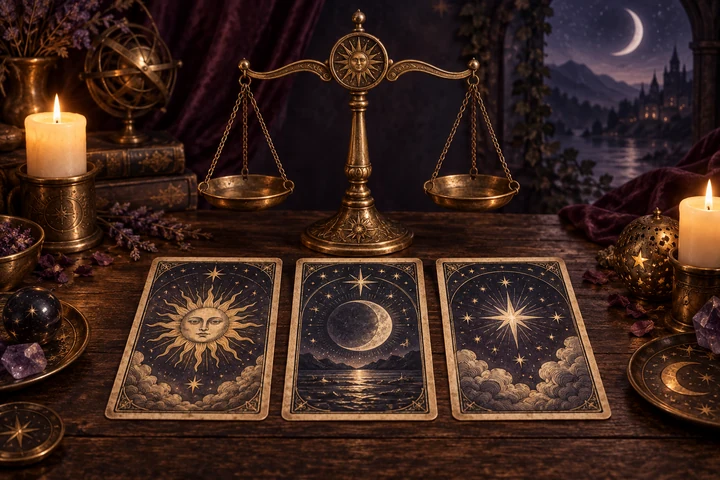
The I Ching, or Book of Changes, is one of the oldest known divinatory texts. Composed in China around 1000 BCE and expanded with Confucian commentaries around 500 BCE, it rests on 64 hexagrams (figures of six broken or solid lines). This app lets you consult the I Ching online, presented in a format close to tarot: you ask your question, the algorithm draws a hexagram, sometimes paired with a changed hexagram, and you read the associated commentary. The wisdom of the I Ching is more contemplative than predictive: it guides you.

What is the I Ching?

The I Ching (易經, Yìjīng) is a Chinese classic made of 64 hexagrams with their judgments and commentaries on each line. Its composition spans the Zhou dynasty (around 1000 BCE) to the Han period, with the addition of the Ten Wings attributed to the Confucian school. Each hexagram combines two trigrams from a set of eight (Heaven, Earth, Water, Fire, Thunder, Wind, Mountain, Lake). The traditional consultation used yarrow stalks or three coins. The I Ching has inspired Chinese philosophy, but also Western thinkers such as Leibniz (binary system) and Jung (synchronicity).

How does this draw work?

You frame an open question, more meditative than predictive: "how do I approach this period?", "what should I understand about this situation?". The app simulates tossing three coins six times, building the hexagram line by line. If some lines are "changing" (three tails or three heads), a second hexagram appears, showing the movement to come. You read the judgment of the main hexagram, the changing lines individually, then the transformed hexagram. The reading is longer than a tarot draw but rich and contemplative.

Tips for reading

The I Ching does not lend itself well to binary questions or urgencies. Prefer deep questions, asked in a calm moment. Read the judgment of the main hexagram first, then the image (poetic commentary), then the changing lines. Do not seek an immediate answer: let the text work on you for a few hours or days. Note the hexagram you received: its relevance often appears in hindsight. An I Ching consulted carelessly answers carelessly.

Frequently asked questions

How old is the I Ching?

The hexagrams and their judgments go back to the start of the Zhou dynasty, around 1000 BCE. The commentaries (Ten Wings), attributed to the Confucian school, were added between the 5th and 2nd centuries BCE. The text as we read it today is therefore the fruit of a thousand years of elaboration.

What are hexagrams?

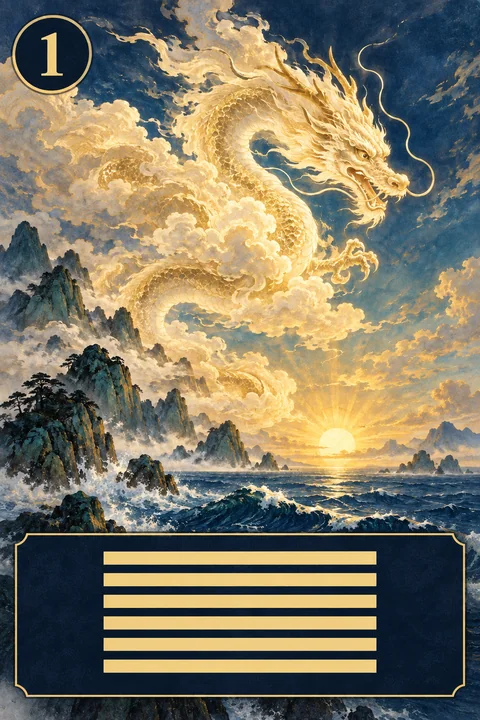
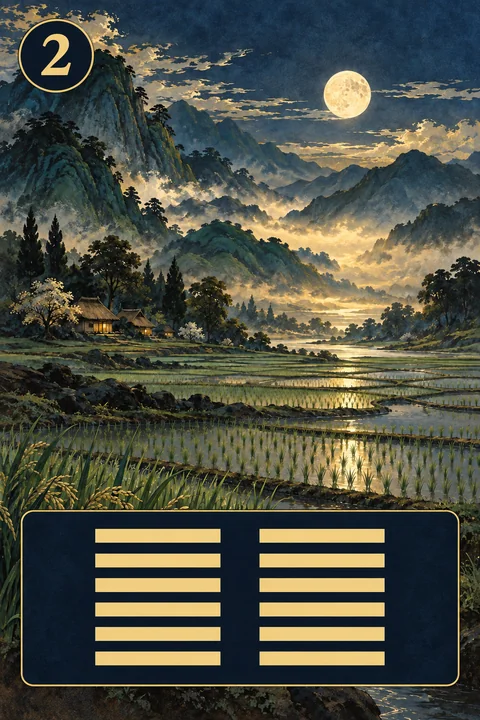
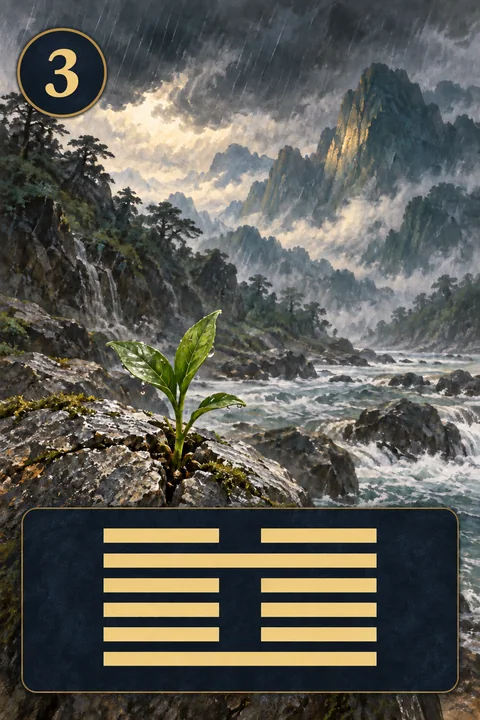
A hexagram is a figure of six stacked lines, each solid (yang, continuous line) or broken (yin, split line). The 64 possible combinations form the heart of the I Ching. Each hexagram breaks down into two trigrams (upper and lower), each corresponding to a natural element: Heaven, Earth, Water, Fire, Thunder, Wind, Mountain, Lake.

Difference with tarot?

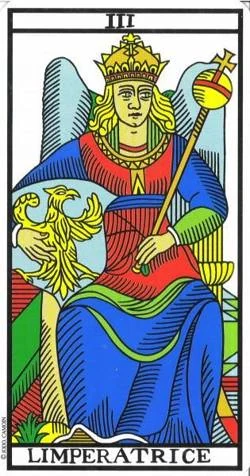
Tarot relies on figurative images (characters, scenes), the I Ching on abstract geometric structures commented on by an ancient text. Tarot is more narrative and suited to everyday questions. The I Ching is more philosophical, contemplative, and better suited to questions of inner stance and right timing.

How do you ask a question?

Frame an open question, without traps or double meanings. "How should I position myself in the face of this change?" is typically a good I Ching question. Avoid "is it", "when", "who": these binary or factual formats fit tarot or Western cartomancy better.