Discover the secrets of the 36 mystical cards
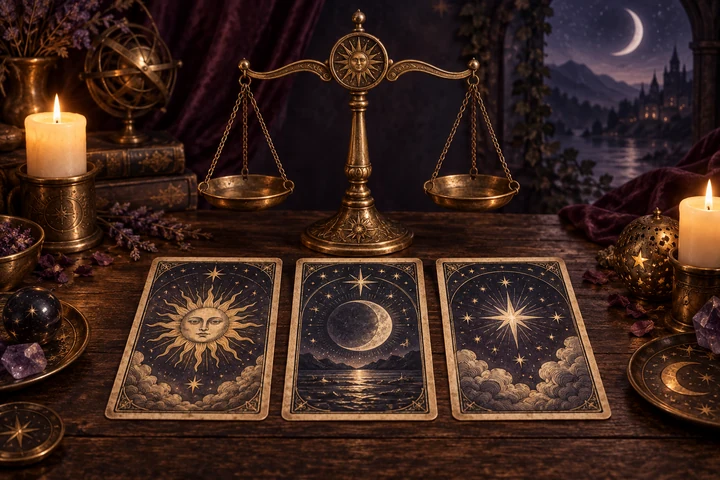
Select 3 cards that call to you
The cards reveal your destiny…
Try Gypsy Tarot now for free. Online reading with AI interpretation in seconds, no signup required.
The Gypsy tarot is a cartomancy inherited from the nomadic traditions of Central and Eastern Europe. Often attributed to the Roma and Sinti communities who spread it from the 18th to the 20th century, it relies on a set of symbols rooted in daily life: the Road, the Star, the House, the Letter, the Traveler. This app lets you draw online using the best-known methods: three-card, five-card, or fan spreads. You frame your question, you draw, you read. The tone is direct and factual, faithful to the spirit of readings done in markets and caravans.
The Gypsy tarot, or Manouche deck, refers to several cartomancies practiced by Roma and Sinti communities since their arrival in Europe between the 14th and 16th centuries. There is no single official Gypsy deck, but rather a family of decks with shared symbols: Road, Traveler, Star, Sun, Moon, House, Letter, Money, Ring, Heart, Cross, Coffin. Most modern editions sold as Gypsy tarot have 36 cards, a structure close to the Petit Lenormand, which is no coincidence: the two traditions crossed paths in 19th-century Europe. The reading favors clarity and concrete events.
You pick your method: one card for a quick question, three cards to map out a situation, five cards in a fan for a fuller reading. You think of your question and you draw. Each card appears with its name and interpretation. The Gypsy tarot reads in combinations close to the Lenormand: two or three neighboring symbols form a sentence. For example, Road + Letter signals news arriving from far away; House + Heart, a happy home. The app provides standalone meanings and a few classic combinations.
The Gypsy tarot suits questions of movement, travel, encounters, mail, and expected money. Ask a concrete question, bounded to a short period (week, month). Avoid abstract philosophical questions. If you draw several cards, read them as a full sentence, not as isolated meanings stacked together. Note your draws: with a few weeks of practice, the combinations become obvious. Do not draw ten times on the same subject: the first answer is the one that counts.
The Gypsy tarot is a cartomancy spread by Roma and Sinti communities, who crossed Europe from northern India starting in the 14th century. The first printed editions of the deck appear in the 19th century in Germany, Hungary, and France, often colored by the European romantic imagination of nomadic life.
Most modern decks sold under this name have 36 cards, sometimes 32 or 52 depending on the edition. There is no single standard: each publisher has its own version. What these decks share is a common symbolic vocabulary centered on travel, home, encounters, and concrete events.
The two decks resemble each other: 36 cards, everyday symbols, combinatorial reading. The Lenormand comes from the German post-1846 tradition and bears the name of a Parisian cartomancer. The Gypsy tarot claims an older Romani lineage. In practice, the reading methods are very close.
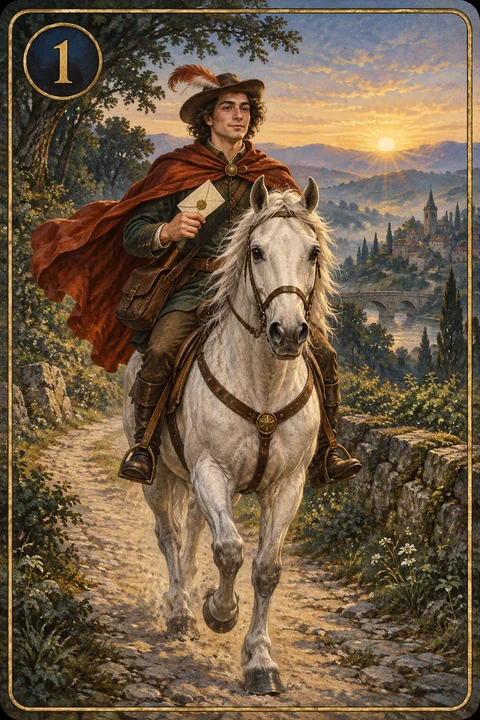
The Traveler (or Rider in some editions) announces movement, a visit, news arriving. Paired with Letter, it is expected mail; with Heart, a romantic encounter; with Money, a gain heading your way. It is an active card, rarely static.