Try Crystal Ball now for free. Online reading with AI interpretation in seconds, no signup required.

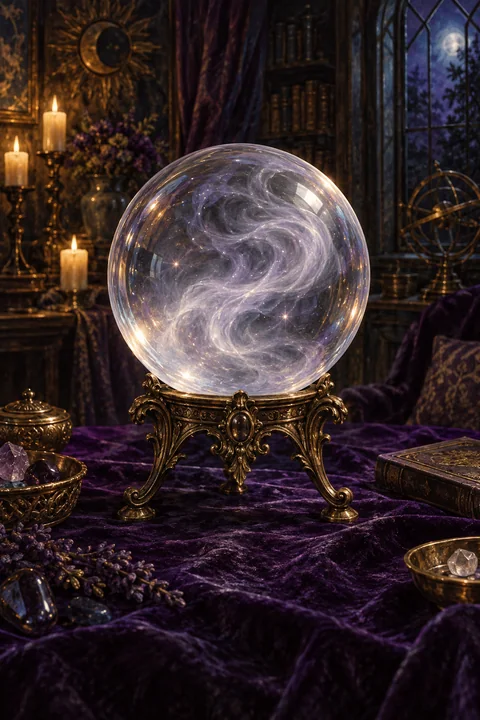
The crystal ball is one of the most recognizable symbols of Western divination. The associated practice, called crystallomancy or scrying, consists of fixing one's gaze on a translucent sphere to discern mental images in it. Codified during the Renaissance by John Dee, mathematician and adviser to Elizabeth I, it belongs to the long tradition of mirror vision, attested as early as Egyptian antiquity. This app reproduces the contemplative experience: you frame a question, you gaze at the animated ball, and you read the message that forms in it. Slow and intuitive, crystallomancy calls above all on concentration and active imagination.

What is crystallomancy?

Crystallomancy, or scrying, is divination by fixing the gaze on a translucent or reflective surface. The rock crystal ball is its best-known medium, but black mirrors, water basins, or obsidian crystals are also used. The practice is attested in ancient Egypt, then among the Greeks and Romans. It was codified in the Renaissance with John Dee (1527-1609), who consulted crystals to communicate with angelic entities, assisted by the medium Edward Kelley. Dee's obsidian mirror, kept at the British Museum, bears witness to this lineage. In the 19th century, crystallomancy became the emblematic attribute of itinerant seers in Europe.

How to consult the crystal ball?

The session begins by settling in a quiet place, with dim light and no direct reflection on the sphere. You place the ball on a dark stand, frame your question, then fix the center of the crystal without blinking excessively. After a few minutes, clouds, shapes, or inner images form. They can be figurative (faces, landscapes) or abstract (colors, motions). You note your impressions without judging them. The app simulates this process: the ball comes alive on screen, shapes emerge, and a synthetic message is offered. Attention, more than the sphere itself, is the real instrument.

Tips for a contemplative session

Practice preferably at dusk, in a room lit by a single candle or a soft lamp. Avoid direct reflections on the ball, which block inner vision. Ask only one question per session, framed in a low voice. Do not force the vision: let the images come up on their own. A session lasts between ten and twenty minutes; beyond that, concentration wears out. Write what you see right after, before the impressions fade. The practice sharpens with regularity.

Frequently asked questions

Why rock crystal?

Rock crystal (transparent quartz) is traditionally chosen for its optical purity and energetic neutrality. Its natural inclusions offer the eye anchor points that help enter the contemplative state. A blown-glass ball works just as well to start the practice.

Who was John Dee?

John Dee (1527-1609) was a mathematician, astronomer, and scientific adviser to Queen Elizabeth I. A major figure of the English Renaissance, he also studied the occult and practiced scrying with his assistant Edward Kelley, creating the angelic system known as Enochian.

Can everyone see in the ball?

The images are not physical but mental: the ball serves as a support for active imagination. Most practitioners develop this capacity through regular training. Some see clear shapes, others sense intuitions or hear inwardly. No sensitivity is better than another.

How long to get started?

A few weeks of regular practice, ten to twenty minutes two or three times a week, are usually enough to begin perceiving images. Patience is essential: the first sessions may yield nothing without that meaning failure.