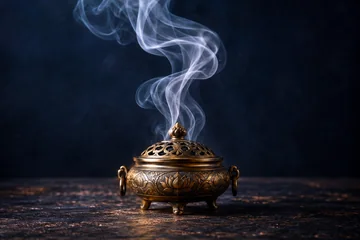
Capnomancy

The Art of Reading Smoke

One of humanity's most ancient divination arts. The priests and shamans of antiquity interpreted the behavior of sacred smoke to decipher messages from the gods. Focus on your question or what occupies your mind, and let the smoke speak.
Try Capnomancy (Smoke) now for free. Online reading with AI interpretation in seconds, no signup required.

Capnomancy is the divinatory art of interpreting smoke. Its name comes from the Greek kapnos, smoke. Attested in the Babylonian tablets of the 2nd millennium BCE, it is among the oldest known forms of divination. Priests observed the smoke from sacrificial altars and read in its swirls the messages of the gods. This app reproduces the contemplative ritual: you frame a question, you light the symbolic combustion, and you read the movement of the smoke. Slow, shifting, never the same twice, smoke remains one of the most poetic divinatory media in the Western tradition.

What is capnomancy?

Capnomancy is the divinatory observation of smoke. It appears in Mesopotamian cuneiform tablets as early as the Old Babylonian period, where the diviners (baru) read the smoke of incense burned on altars. Ancient Greece took it up within the framework of oracles, notably at Delphi, and Rome integrated it into the rites of the haruspices. In the Middle Ages, capnomancy survived in the incense practices of religious and magical ceremonies. It is distinct from libanomancy, divination by the burning incense itself, and from pyromancy, which observes the flame. Its specificity is the attention paid to the movement of the swirls, their density, and their direction.

How do you read smoke?

You light an incense stick, a candle, or a sprig of bay laurel, in a quiet room sheltered from drafts. You frame your question silently, then watch the smoke for several minutes. Smoke that rises straight announces a clear and favorable answer. Smoke that leans to the right signals success, to the left an obstacle. Dense swirls evoke abundance or confusion depending on the context; thin threads suggest subtlety or fading. Smoke that falls to the ground is an ill omen in the ancient tradition. The app simulates these movements and offers the associated reading.

Tips for accurate observation

Work in dim light to see the swirls better against a bright background. Avoid fans and open windows, which distort the reading. Choose natural incense, free of synthetic fragrance: frankincense, myrrh, or white sage remain the most traditional. Focus on the first minute after lighting, when the smoke is most expressive. Do not force the interpretation: if the smoke remains undefined, the question may be premature or poorly framed.

Frequently asked questions

Where does capnomancy come from?

It is attested as early as the 2nd millennium BCE in Mesopotamia, where diviners read the smoke of incense altars. Babylonian tablets describe the patterns to observe precisely. It then spread to Greece, Rome, and medieval Europe via religious and magical rites.

What does falling smoke mean?

In the ancient tradition, smoke that falls to the ground instead of rising is a bad omen. It indicates a block, a project that will not succeed, or a harmful influence around the question. It is advisable to delay the decision and to air the room.

What is the difference with pyromancy?

Pyromancy observes the flame itself: its color, height, and crackling. Capnomancy focuses exclusively on the smoke that rises from it. The two practices are often combined in ancient rituals but constitute two distinct readings.

Which incense is best?

Frankincense and myrrh, the oldest divinatory incenses, remain recommended. White sage suits questions of protection. Sandalwood helps concentration. Avoid synthetic perfumed incenses, whose smoke is too dense and hard to read.