Das Orakel des Kaffeesatzes
Try Coffee Reading now for free. Online reading with AI interpretation in seconds, no signup required.
Cafeomancy is the divinatory art of interpreting the figures drawn by coffee grounds at the bottom and on the walls of an inverted cup. Born in the Ottoman Empire in the 15th century alongside the spread of Turkish coffee, it spread across the Middle East, the Balkans, and the Mediterranean rim before reaching Western Europe in the 17th century. This app reproduces the traditional reading: you discover the main figures, their place in the cup, and their meaning. The ritual stays simple, slow, and contemplative, faithful to the practice of Istanbul and Greek coffee houses.
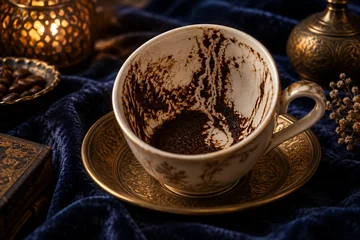
Cafeomancy, sometimes called tasseomancy when applied to tea, is a form of divination through residue reading. It uses finely ground, unfiltered coffee brewed Turkish or Greek style. After drinking, the cup is turned over onto the saucer and observed. The patterns left by the grounds, animals, objects, letters, or miniature landscapes, are interpreted based on their shape, position, and proximity to the handle. Historically attested as early as the 15th century in the Ottoman Empire, the practice has been codified over the centuries, producing a precise symbolic vocabulary passed down in families and traditional cafes.
You drink the coffee slowly, focusing your thought on a question. Once the cup is empty, you cover it with the saucer, turn it over with a circular gesture, and let it rest one or two minutes so the grounds flow. Lifting the cup, you observe the figures formed. The zone near the handle concerns the querent and their close circle, the bottom evokes the distant past or obstacles, the walls show present and future evolutions. Each recognizable shape, bird, heart, number, is noted and cross-referenced with its location to build a coherent reading.
Use a white cup with a light, plain bottom to see the figures clearly. Brew authentic Turkish coffee, unfiltered, ideally without sugar. Frame a precise question before drinking, and stay attentive to your first impression: cafeomancy relies heavily on free association. Do not try to see figures everywhere. Write down the shapes you identify before looking up their meaning, to avoid biasing your reading. Practice regularly: symbol recognition sharpens with experience.
Cafeomancy arose in the Ottoman Empire in the 15th century, alongside the spread of Turkish coffee. It reached Europe in the 17th century via Venice and Vienna and became especially popular in the Balkans, Greece, and Lebanon, where it is still practiced today in a social, family setting.
Figures near the handle concern the querent directly, their home, or close relations. The clearer the shape and the closer to the rim, the more recent or imminent the event. Conversely, figures at the bottom relate to the past or to the roots of a situation.
Yes, Turkish or Greek coffee, very finely ground and brewed unfiltered in a cezve, is essential. The grounds must remain abundant and sticky enough to cling to the walls. A filtered coffee or an espresso does not leave enough residue for the reading.
A traditional reading takes between ten and thirty minutes. The inverted cup rests for about two minutes, then the interpretation unfolds slowly, figure by figure, moving from the rim toward the bottom.