Velomancy
The Art of Reading Flames
Light the sacred candle, silently formulate your question and observe how the flames reveal the messages of the universe.
The Art of Reading Flames
Light the sacred candle, silently formulate your question and observe how the flames reveal the messages of the universe.
Try Candle Reading now for free. Online reading with AI interpretation in seconds, no signup required.
Velomancy, also called ceromancy, is the divinatory art of interpreting the drippings and shapes taken by the wax of a melting candle. Practiced across the Mediterranean basin since Roman antiquity, it has survived in popular Italian, Greek, and Latin American traditions, often paired with protection rituals. This app reproduces the gesture: you symbolically light a candle, observe the falling wax, and read the figure formed. Slow and contemplative, velomancy unites light, fire, and transformed matter in a single divinatory meditation.
Velomancy, from the Latin velum which gave "candle", is synonymous with ceromancy, from the Greek kêros, wax. The practice consists of letting melted wax drip into cold water or onto a flat surface, then interpreting the shapes obtained. It is attested in ancient Rome under the name ceromantia, mentioned by several Latin authors. It survived in Mediterranean and popular Catholic traditions, where the candle held a central ritual place, but also in santería and candomblé practices in Latin America, inherited from Afro-Caribbean cults and fused with the devotion to saints.
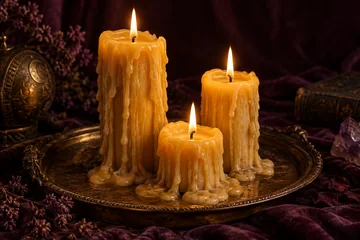
You light a candle, traditionally white for neutrality or colored according to the question. You frame your intention, then let the wax flow freely. Two methods coexist: the wax that builds up around the candle is read in place; or you quickly pour it into a bowl of cold water to obtain a floating figure. Recognizable shapes (animals, letters, objects) are interpreted along a symbolic repertoire. Vertical drips evoke a direct path, splatters mean scatter, compact wax announces stability. The app reproduces this dynamic with a generated figure and its interpretation.
Pick a quiet spot, free of drafts, so the flame stays stable. A lively and upright flame points to favorable energy; a dancing or noisy flame signals tension around the question. Favor natural-wax candles, more expressive than industrial paraffins. Note the figures as soon as they appear, before they cool and freeze into a less readable shape. Blow out the candle at the end of the session with an intention of gratitude.
Both terms refer to the same practice. Ceromancy is the scholarly form of Greek origin (kêros, wax), velomancy derives from the Latin velum and remains rarer. Modern usage mostly employs ceromancy, but velomancy lingers in some old French treatises.
A candle that weeps heavily, meaning it produces a lot of melted wax on one side, is traditionally read as a sign of strong emotion around the topic, or of tension to release. It is also a sign to pay particular attention to the reading.
Yes, in tradition. White means purity and neutrality, red love and passion, green money and health, blue peace and the spirit, black protection. For a general reading, the white candle remains the most versatile choice.
Yes, the hardened wax keeps the formed figures and can be re-examined with a clear head. Some practitioners keep the most expressive fragments as memory objects of an important session, provided they store them away from the daily living space.