Das Würfelorakel enthüllt, was der Zufall verbirgt
Wähle deinen Wurf
Die Würfel rollen…
Try Dice Reading now for free. Online reading with AI interpretation in seconds, no signup required.
Dice divination, better known by its scholarly name cubomancy, is the divinatory art of interpreting the result of a dice throw. It belongs to the broad family of cleromancy, divination by lot, attested as early as Greek and Roman antiquity. The six-sided die, one of the oldest known game objects, served very early on to question the gods. This app reproduces the ritual: you frame your question, you throw two or three dice, and each numerical combination receives an interpretation inherited from 19th-century European divinatory manuals.
Dice divination, or cubomancy, is the divinatory reading of dice. The scholarly term cubomancy derives from the Greek kubos, the cube. It is a specific form of cleromancy, the broader family of lot-based divinations, which also includes knucklebones and small sticks. The Greeks consulted dice oracles as early as the 3rd century BCE, such as the Astragaloi oracle in Asia Minor. The Romans practiced the sortes, drawings of tablets or dice in temples. In the 19th century, dice divination was codified in popular European manuals, which assigned a meaning to each sum obtained, usually with two or three six-sided dice.
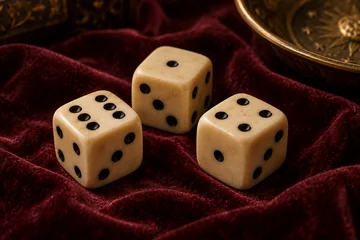
You take two or three six-sided dice. You frame your question, then throw them onto a bounded flat surface, traditionally a chalk-drawn circle. Dice that fall outside the circle are re-thrown or ignored. You add the values obtained, which gives a sum between 2 and 18. Each sum has an interpretation: 3 augurs a happy surprise, 7 advises caution, 12 promises success after effort, 18 marks the peak of a situation. The app calculates the sum and displays the traditional commentary, also taking into account notable combinations such as doubles or triples.
Ask a precise but open question: "how will this project evolve?" rather than a simple yes or no. Throw the dice in a single gesture, without hesitation. Three dice give a more nuanced reading than two but require more attention. Do not consult the same question more than once a day: the result would lose meaning. Keep a draws journal to spot, over the long run, the consistency or repetition of certain numbers in your life.
The term derives from the Italian dado, the die, and the Greek suffix -mancy, divination. It is less common in English than "cubomancy", but remains used in some popular European treatises of divinatory arts, especially southern ones.
A double, that is two dice showing the same value, reinforces the meaning of the number obtained. A double-six announces a striking success, a double-one warns of a delay or difficulty. A triple is even more marked and statistically rare.
The European tradition mostly uses three six-sided dice. Two are enough for a short, binary reading; three give more nuance in the sum and allow notable combinations to appear. Beyond that, the reading grows complex without real gain.
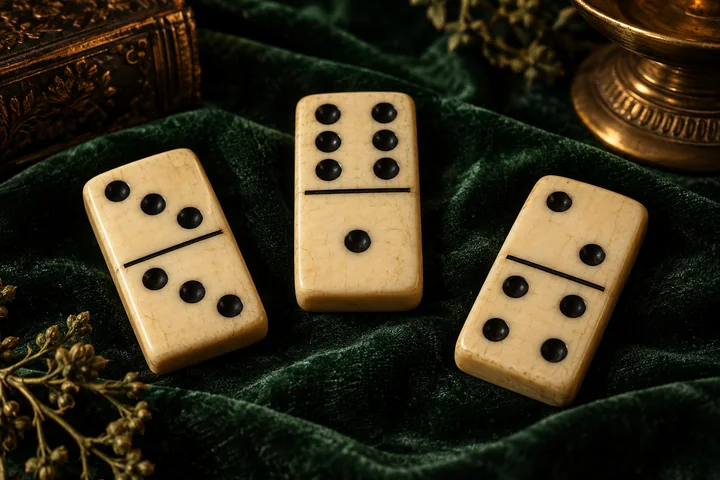
Yes. Cubomancy uses six-sided dice thrown, while dominomancy rests on drawing one or several domino tiles, which combine two values on the same piece. The symbolic repertoires are close but distinct.