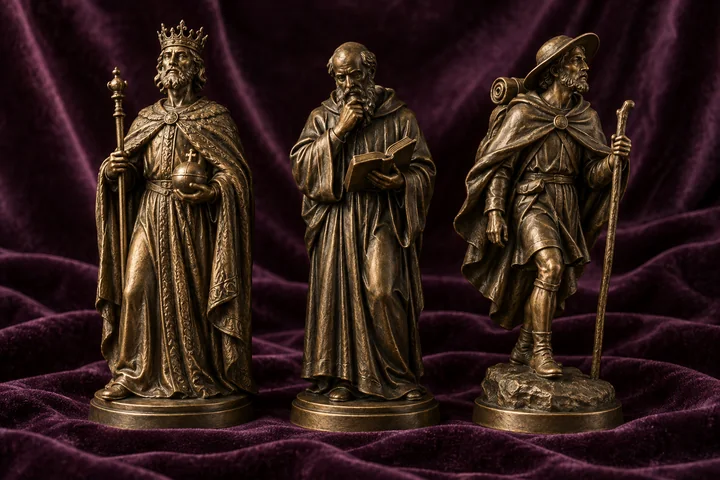
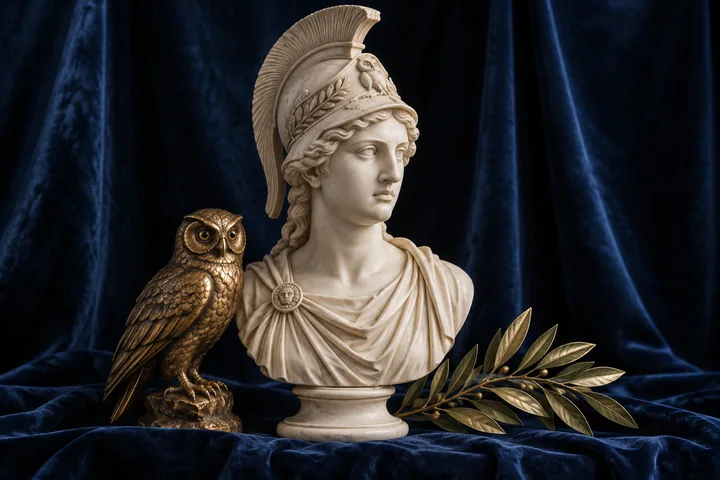
Beantworte 8 Fragen über deine tiefsten Instinkte und entdecke ein mögliches Leben, das deine Seele bereits gelebt hat.
Deine vergangenen Leben werden erkundet…
Seelenerinnerungen tauchen langsam auf
Try Past Lives Test now for free. Online reading with AI interpretation in seconds, no signup required.
The past lives test offers a symbolic exploration of your profile through the major eras of human history and the cultural archetypes tied to them. Based on your answers, the app identifies the historical context that resonates most with your relationship with the world: ancient Egypt, classical Greece, medieval times, Renaissance, Victorian period, ancient East, or other. The result comes as a symbolic narrative and not as a claim of reincarnation in the strict sense. This is a tool of narrative introspection, with no diagnostic value or proof of a past existence.
Reincarnation refers to the belief that a soul is reborn into a new body after death. It structures several traditions: Hinduism through samsara set out in the Upanishads (8th-6th century BCE), Buddhism with its concept of conditioned continuity, Pythagoreanism and Orphism in ancient Greece, and certain Kabbalistic currents with gilgul. In the modern West, past life therapy appears in the 20th century, notably through the work of the psychiatrist Brian Weiss (Many Lives, Many Masters, 1988). No past existence has been scientifically demonstrated. The test borrows this vocabulary for introspective and narrative purposes, without claiming to establish a metaphysical truth.
The questionnaire has about twenty multiple-choice questions on your aesthetic, geographic, cultural, and emotional affinities: a landscape that spontaneously attracts you, an era that fascinates you, a type of object, a relationship with nature or the city. Each answer is weighted and distributes points across several eras and symbolic roles (artisan, scribe, navigator, healer, scholar, traveler). After the test, the app identifies a dominant era and an associated role, then offers a short narrative depicting this symbolic life. A secondary profile nuances the result.
Take the result as a narrative mirror, not as an authentic memory. What you call a "past life" here refers to a strong cultural or aesthetic affinity, worth questioning. If an era has attracted you since childhood, ask which values or sensations it holds for you. Note the details that resonate and those that slip past. Avoid investing the result as an explanation of current difficulties; serious therapeutic approaches prefer to work with present experience rather than a hypothetical past.
No. No scientific method has established the existence of past lives. Case studies such as those of Ian Stevenson at the University of Virginia are contested by most of the scientific community. The test offers a symbolic reading of cultural affinities, with no claim of proof.
Several explanations coexist: upbringing, reading, films, familiar landscapes, aesthetics. Psychology speaks of acquired affinities and narrative projection. Traditions of reincarnation see in it a soul memory. The test stays neutral and simply offers a frame to explore this attraction.
Yes, as long as you take it as a revealing story. Choosing, for instance, a life as an Alexandrian scribe often signals a valuing of knowledge, archive, or studious withdrawal. Meaning is built in the connection between the narrative obtained and your current life.
No. The test can be approached from a purely symbolic or literary angle, as one would read a historical novel. People who hold to reincarnation can use it as a meditation prompt, but this stance is neither required nor encouraged by the tool.