LABORATORY FOR PARAPSYCHOLOGY · EST. 1930

1 / 25
?

Try Extrasensory Perception Test now for free. Online reading with AI interpretation in seconds, no signup required.

The extrasensory perception test evaluates your subjective relationship with intuition, synchronicity, and fine attention to weak signals. It does not measure a paranormal capacity: no extrasensory perception has been demonstrated in the lab under current scientific protocols. The app rather identifies your cognitive style: visual intuitive, bodily felt sense, ear for coincidences, reading of atmospheres. You get a dominant profile and a secondary profile that describe your way of paying attention to what escapes rational analysis. This is a tool of symbolic introspection, with no diagnostic value.

Extrasensory perception, intuition, and science

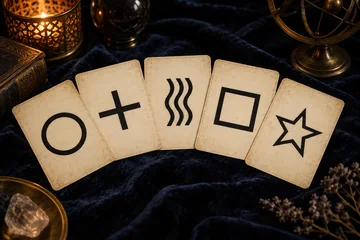
The term extrasensory perception or ESP was popularized by the American psychologist Joseph Banks Rhine at Duke University in the 1930s, around experiments on telepathy and clairvoyance with Zener cards. Since then, many studies have attempted to reproduce these results, without robust success. The meta-analyses published in journals such as Psychological Bulletin conclude that no paranormal capacity has been reproducibly established. Intuition, on the other hand, is a recognized object of study in cognitive psychology: Daniel Kahneman, in Thinking, Fast and Slow (2011), describes it as fast, non-conscious processing of learned information. The test mobilizes this second meaning of the word.

How the test works

The questionnaire has about twenty multiple-choice questions on your relationship with hunches, coincidences, atmospheres, dreams, body signals, and quick decisions. Each answer is weighted and distributes points across several styles: visual intuitive, kinesthetic, inner auditory, attentive to Jungian synchronicities, or reader of atmospheres. After the test, the app identifies a dominant profile and a secondary one, then describes your particular way of catching and interpreting weak signals. The result includes a few paths to cultivate this sensitivity without confusing it with objective certainty.

Tips for interpreting your profile

Treat your intuition as a hypothesis to verify, not as a certainty. Keep a journal of hunches with date, content, and actual outcome; after a few months, confirmation bias becomes visible. Learn to distinguish trained intuition, grounded in expertise, from a mere projected desire. The notion of synchronicity coined by Jung in 1952 describes meaningful coincidences: it opens a useful line of questioning, without constituting proof. Cultivate attention without dramatizing signals. Methodical doubt remains compatible with perceptive finesse.

Frequently asked questions

Does the test measure a paranormal gift?

No. No paranormal capacity has been validated in the lab under current scientific standards. The test does not assess telepathy or precognition. It describes your cognitive style and your subjective relationship with weak signals, intuition, and synchronicities, with no claim to measure an extrasensory faculty.

Does intuition really exist?

Yes, but in the cognitive sense. Daniel Kahneman and Gary Klein describe it as fast processing of learned information, particularly reliable in stable areas of expertise. Outside those areas, it often proves biased. The test takes up this reasonable definition of intuition.

What are synchronicities according to Jung?

Carl Gustav Jung introduces the term in Synchronicity and Paracelsica (1952). It refers to meaningful coincidences between a psychic event and an outer event, with no apparent causal link. The notion remains contested outside analytical psychology, but it offers a frame for observing the correspondences that catch attention.

How do I avoid overinterpreting my hunches?

Keep a journal and record the objective result of your hunches. Compare the number of confirmed hunches with the total formulated. Confirmation bias pushes us to remember only the winning calls. This simple practice recalibrates perception and avoids drifting into magical thinking.