Das Buch der Wandlungen
Try I Ching Oracle now for free. Online reading with AI interpretation in seconds, no signup required.
The I Ching, or Yi Jing (易經), literally the "Book of Changes", is one of the oldest Chinese texts. Its initial writing dates from the start of the Zhou dynasty, around 1000 BCE, and tradition attributes it to King Wen and the Duke of Zhou. This oracle rests on 64 hexagrams, each formed of six solid (yang) or broken (yin) lines. The Confucian commentaries, called the Ten Wings, made it a major classic of Chinese thought. The modern consultation reproduces the draw with coins or yarrow stalks.
The 64 hexagrams arise from the combination of eight foundational trigrams (bagua) attributed to the mythical emperor Fuxi. Each hexagram carries a name (Qian, Kun, Zhun...), a judgment, and a line-by-line analysis. In the 4th century BCE, Confucius and his school added the Ten Wings, which turned the divinatory manual into a treatise of wisdom. The text was translated into Latin by the Jesuits in the 17th century, then into German by Richard Wilhelm in 1924, a translation that Carl Gustav Jung prefaced and that brought the I Ching widely into the West.
Frame an open question, ideally in the first person. The app simulates tossing three coins six times in a row, the coin method popularized from the 1st century onward. Each toss produces a yin or yang line, sometimes a changing line. Together they form a primary hexagram and, if changing lines appear, a derived hexagram showing the situation's evolution. You receive the judgment, the image, and the commentary on the moving lines. This double structure allows analysis of both the present state and the transformation underway.
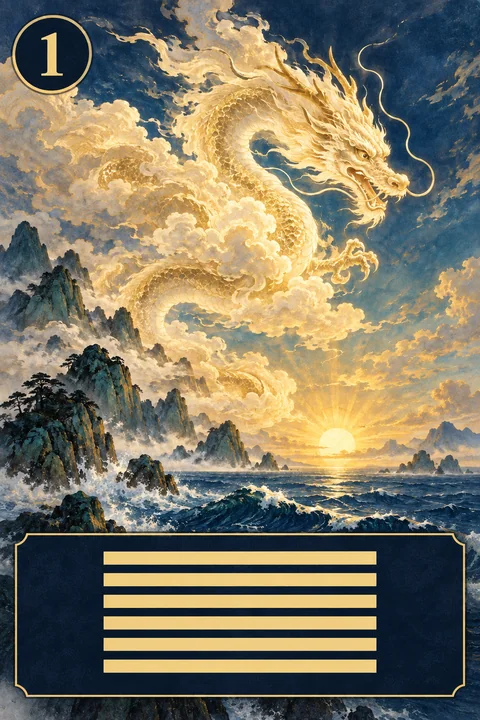
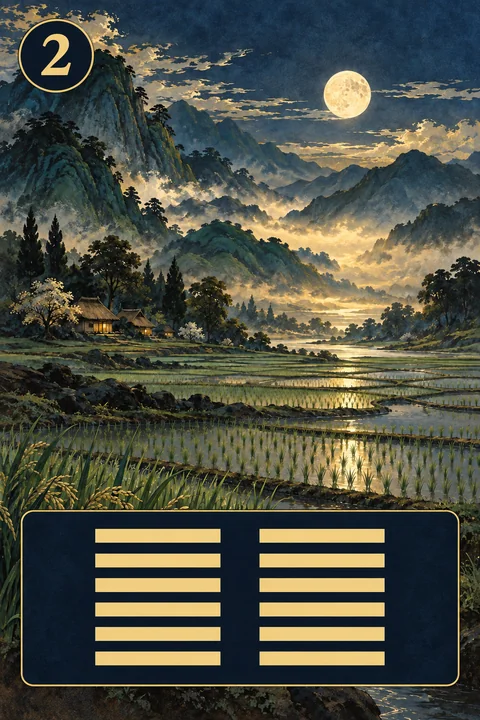
Avoid closed yes/no questions: the I Ching answers better when asked about the right stance to take. Read the judgment first, then the image, and only then the changing lines. Note the hexagrams in a journal to track recurring patterns. Qian (the Creative) and Kun (the Receptive) are the foundational poles of the system. The reading requires a meditative pause: returning to the text several hours later often reveals further meaning.
Richard Wilhelm's translation, rendered into English by Cary F. Baynes, has been the reference since 1950. More recent translations by John Minford or Stephen Karcher offer a more contemporary reading. Both work well for consultation and complement each other.
Yarrow stalks, the oldest method, require some fifty manipulations and favor a meditative state. Coins, faster, slightly alter the probability of changing lines. Both methods remain valid and produce statistically comparable hexagrams.
A changing line (old yin or old yang) marks a point of transformation. It is read in the primary hexagram, then flips to form the second hexagram. This mechanism illustrates the Chinese philosophy of permanent change at the core of the Yi Jing.
Tradition advises restraint: one consultation per subject, with a pause for reflection between draws. Daily use dilutes attention to the text. It is better to dwell on one hexagram across several days than to string together successive draws.