Tarotoui
  • Tarot
  • Tarot Answers
  • Oracles
  • Mancy
  • Astrology
  • Numerology
  • Horoscopes
  • Tests
  • Glossary
⟡

Arithmomancy — The Art of Sacred Numbers

PYTHAGOREAN NUMEROLOGY · WESTERN ARITHMOMANCY

✦ ✦ ✦
· · ·

"Numbers rule the universe." — Pythagoras

Try Arithmancy now for free. Online reading with AI interpretation in seconds, no signup required.

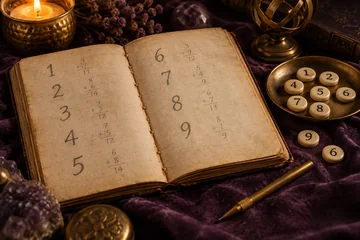
Arithmomancy, from the Greek arithmos (number) and manteia (divination), refers to the ancient variant of numerology practiced by the Greeks, then by Hellenized Jews (gematria) and the early Christians. It converts the letters of the name into numerical values according to the Greek alphabet, where each letter has a traditional value distinct from the Latin alphabet. Our free tool transliterates your name, applies the ancient Greek table, and offers an encyclopedic symbolic reading, to be used as a tool of cultural introspection and not as prediction.

What is arithmomancy?

Arithmomancy is attested as early as Greek antiquity and was practiced by the Pythagoreans, heirs of Pythagoras (6th century BCE), for whom "all is number". It was adopted by the Romans, then by the Alexandrian commentators. The Greek system gives each letter a value: alpha=1, beta=2, gamma=3... iota=10, kappa=20... rho=100, sigma=200, etc. This correspondence, distinct from modern Pythagorean numerology codified by Mrs L. Dow Balliett in the early 20th century and systematized by Juno Jordan, gives access to a gematric reading of the name, famous for producing the "number of the beast" (666) in the Book of Revelation. Like all numerology, arithmomancy is not a scientific discipline: it is a symbolic heritage of introspection.

How is it calculated?

Your birth name is transliterated into Greek characters (alpha for A, beta for B, etc.), then each letter is given its value of ancient Greek isopsephy: α=1, β=2, γ=3, δ=4, ε=5, ϝ=6, ζ=7, η=8, θ=9, ι=10, κ=20, λ=30, μ=40, ν=50, ξ=60, ο=70, π=80, ϟ=90, ρ=100, σ=200, τ=300, υ=400, φ=500, χ=600, ψ=700, ω=800. You add the values obtained. The total can be interpreted as is — the ancient tradition gave weight to large numbers — or reduced in modern fashion to a digit between 1 and 9, preserving the master numbers 11, 22, and 33. Each value is then tied to mythological, planetary, and symbolic correspondences inherited from the Hellenistic tradition.

Tips for sound interpretation

Treat arithmomancy as a dialogue with antiquity. Compare its result with that of modern Pythagorean numerology: if the two digits converge, the reading is reinforced; if they diverge, you hold two complementary facets. Note the mythological correspondences (Apollo, Hermes, Athena...) suggested by your number and notice if some speak to you intuitively. Avoid overinterpreting gematric coincidences with ancient texts: it is an intellectual game, not a revelation. For a non-Greek name, the transliteration can have variants; testing several spellings and keeping the one that resonates is part of the traditional practice.

Frequently asked questions

Difference with modern numerology?

Modern Pythagorean numerology uses the digits 1 to 9 assigned to Latin letters along a simple cycle. Greek arithmomancy assigns values spread from 1 to 800 across 24 letters, without cycle. It therefore produces larger totals and readings more tied to Hellenistic mythology than to contemporary psychology.

My name is not Greek, is that a problem?

No. Your name is phonetically transliterated into the Greek alphabet. Some Latin letters (C, J, W) have no direct equivalent and are rendered by the closest sounds (K, I, OU). This share of interpretation explains why two numerologists can get slightly different totals for the same name: the practice remains artisanal.

Is it tied to the 666 of Revelation?

Yes, indirectly. The "number of the beast" is a famous example of arithmomancy: the early Christians, lettered in Greek, identified figures by the gematric sum of their name. This example shows the cultural reach of the method, without implying a prophetic use applicable to your daily life.

Is it an exact science?

No. Arithmomancy has no experimental validation and is not recognized by contemporary science. It is a cultural and symbolic heritage, interesting for exploring one's name through the lens of Greek antiquity. Its value lies in the historical depth it opens, not in an objective measure.

Also explore

Destiny numerologyTry Destiny Numerology now for free. Online reading with AI interpretation in seconds, no signup required. Personality numerologyTry Personality Numerology now for free. Online reading with AI interpretation in seconds, no signup required. Karmic numerologyTry Karmic Numerology now for free. Online reading with AI interpretation in seconds, no signup required. Shadow numerologyTry Shadow Numerology now for free. Online reading with AI interpretation in seconds, no signup required. Numerology HubNumerology calculators online with AI: destiny, personality, motivations, karma, shadow, predictive, compat…

Free esoteric tools with AI interpretation.

© 2026 Tarotoui — All rights reserved.

PrivacyCookiesDisclaimerContact