Entdecke dein Maya-Tierkreiszeichen und sein Schicksal
Try Mayan Horoscope now for free. Online reading with AI interpretation in seconds, no signup required.
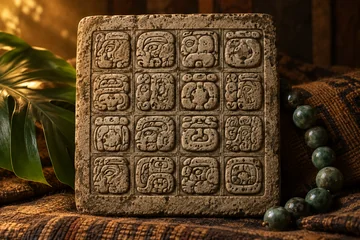
The Maya horoscope rests on the tzolkin, the Mesoamerican sacred 260-day calendar. It combines twenty day signs (daily glyphs such as Imix, Ik, Akbal, Kan...) with thirteen tones, producing 260 unique combinations. Each day of the tzolkin is thus paired with a sign and a tone that color its meaning. Our tool converts your Gregorian date of birth into a tzolkin date and returns the matching profile, in the tradition of Maya astrology studied by ethnologists and popularized by some modern authors.
The Maya horoscope rests on the tzolkin (or cholq'ij in Quiché), a ritual 260-day cycle used by Mesoamerican civilizations well before the arrival of the Spanish. The tzolkin combines twenty daily signs, each naming an entity or principle (Crocodile, Wind, House, Seed, Snake, Death, Deer, Rabbit...), with thirteen tones. Documented in the Dresden Codex (12th-13th centuries) and the Popol Vuh recorded in the 16th century, the tzolkin is still used today by the ajq'ijab, time-keeping priests of the Guatemalan Maya communities. Contemporary uses draw on these traditions while reinterpreting them.
To obtain your Maya profile, enter your Gregorian date of birth. The tool converts this date into a sign + tone combination of the tzolkin, using the correspondence tables established by academic Mayanism, especially through the GMT correlation (Goodman-Martínez-Thompson), which anchors the tzolkin onto the Gregorian calendar. The time and place of birth are not needed: the tzolkin assigns a sign and a tone to each whole day, without hourly subdivision. The result pairs a major symbolic figure with your date of birth.
Read your sign (Kin) first as a life theme, then your tone (from 1 to 13) as a quality of energy: emergence, consolidation, rhythm, stability, etc. Modern schools also offer a castle and an earth family, contemporary elaborations that do not appear as such in pre-Columbian sources. Always distinguish the historical Maya tradition, still alive in Guatemala and Mexico, from the New Age reinterpretations that appeared from the 1980s onward, especially around the work of José Argüelles.
Several hypotheses exist. The most likely connects the tzolkin to the average length of human pregnancy and the agricultural cycle of maize in Mesoamerica. Others see it as the interval between two zenith passages of the Sun at certain latitudes of southern Mexico. The combination 13 × 20 also reflects a vigesimal numbering system specific to the Maya.
The GMT correlation, named after Joseph Goodman, Juan Martínez Hernández, and J. Eric S. Thompson, is the most widely accepted alignment between the Maya Long Count calendar and the Gregorian calendar. It places the initial date of 4 Ahau 8 Cumkú on August 11, 3114 BCE. Our tool relies on this correlation.
No. The date of December 21, 2012 corresponded to the end of a 13 baktun cycle of the Long Count, not of the tzolkin. No ancient Maya inscription mentions an end of the world on this date: it is a modern and largely media-driven interpretation. The Maya saw this passage as a cyclical renewal of time.
Yes, especially in Guatemala, where Maya-Quiché ajq'ijab still pass on the ritual calendar as a tool of divination, care, and ceremonial organization. This living knowledge differs, however, from the version popularized in Europe and North America, which is more syncretic and influenced by contemporary New Age spirituality.