Check Moon phases, illumination and upcoming new and full Moons. Browse the months and choose your time zone. Free, with no registration.
The Moon reflects sunlight. During its cycle, the illuminated portion we see from Earth changes. New Moons are about 29.5 days apart on average; the phases follow a continuous progression.
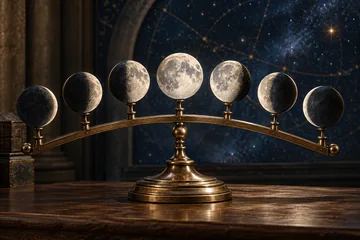
New Moon: the visible disc is almost unlit. Waxing crescent: a slim illuminated shape grows. First quarter: roughly half the disc appears lit. Waxing gibbous: the illuminated portion exceeds half and continues to grow.
Full Moon: almost the entire disc appears illuminated. Waning gibbous: the visible light begins to decrease. Last quarter: roughly half the disc appears lit again. Waning crescent: an increasingly thin shape remains before the next new Moon.
Check the time zone and use the arrows to move to the previous or next month. The “Today” card keeps showing the current phase, illumination and Moon sign even while you browse another month. The two upcoming-event cards also count forward from now.
Each small Moon represents 12:00 in the selected zone. A main-phase label and its time mark a different instant within that day. For example, if a full Moon is marked at 22:00, the noon picture still represents a few hours earlier. Illumination is rounded and the phase name summarises part of the cycle: it does not mean the entire day is the exact full-Moon instant.
Times are approximate. You can browse months from 1900 to 2100; historical time offsets, particularly before 1970, may carry uncertainty. The calendar does not calculate moonrise or visibility from your location.
Astrology and various contemporary practices use the cycle as an image of beginning, development, review and closure. These are symbolic associations: they do not require you to feel a particular emotion or guarantee a successful decision on a given date.
Try a journal page for a small project: at new Moon, write an intention; while the Moon waxes, note a possible step; at full Moon, review what happened; while it wanes, decide what to adjust or leave behind. If you need to act today, there is no need to wait for another phase. The calendar accompanies reflection; you choose the pace.